Astrophysics/Astronomy
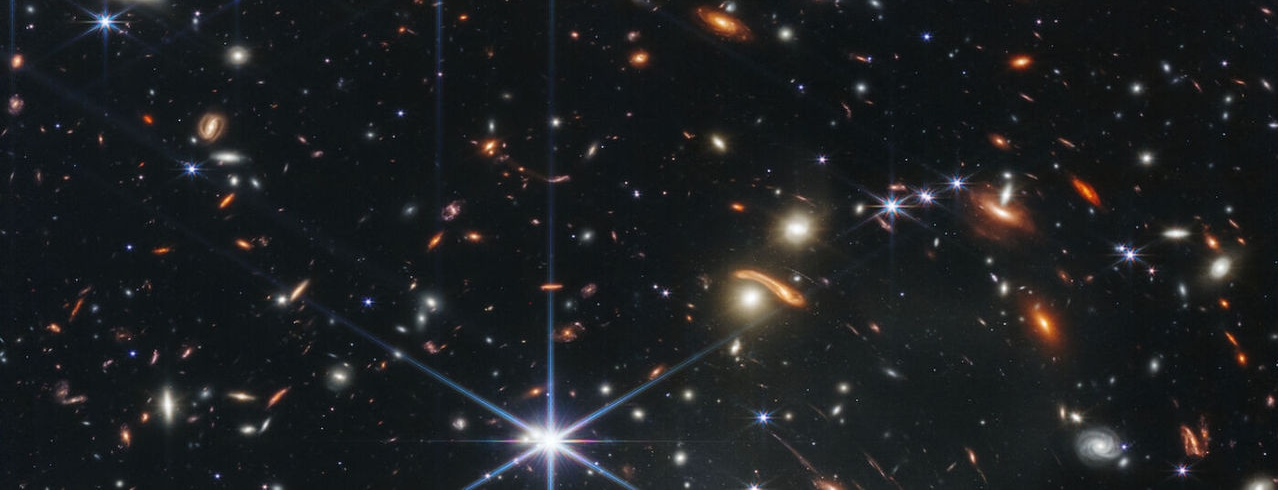
Telescopes allow us to study distant objects and look back in time. Astrophysics researchers at University of Cincinnati use data from telescopes to learn about the origin of our universe and how it evolved to its present state. We seek to answer questions about galaxy evolution, dark energy, dark matter, and fundamental physics. Activities in our group span instrumentation, observation, theory, data analysis, and simulation.
University of Cincinnati Department of Physics maintains ties to the Cincinnati Observatory, which was the first public observatory in the western hemisphere. The Observatory has two historic refracting telescopes and hosts a variety of outreach events for the general public.
Dr. Matthew Bayliss works on a variety of problems in observational astrophysics and cosmology involving galaxy clusters, the first generation of galaxies, and gravitational lensing. Galaxy clusters are the largest structures in the universe and contain on the order of 1000 individual galaxies bound within a common gravitational potential well. Galaxy clusters contain sufficiently large concentrations of mass that they often produce dramatic gravitational lensing effects in which the galaxy cluster mass distribution acts as a natural magnifying glass that bends light from distant background sources. Dr. Bayliss uses galaxy cluster gravitational lensing phenomena to study both the (foreground) galaxy cluster lenses, as well as the magnified distant (background) sources. He is an observer/experimentalist and uses a wide range of facilities for research, including orbital NASA observatories like the Hubble Space Telescope, the James Webb Space Telescope, and the Chandra X-ray Observatory. He also makes frequent use of large ground-based observatories, including the Magellan and Gemini telescopes. To learn more, see his website.
Dr. Colin Bischoff studies the polarization of the Cosmic Microwave Background (CMB) using the BICEP series of telescopes at the South Pole. The CMB is a relic radiation field that was emitted shortly after the Big Bang. By studying CMB polarization, he hopes to detect a signal of primordial gravitational waves that are predicted by inflation, the leading theory to explain the initial conditions of our universe. Two currently operating telescopes, BICEP3 and BICEP Array, produce the most sensitive CMB polarization data to date for this purpose. Dr. Bischoff’s research activities include instrumentation, telescope operations, and data analysis, with a focus on polarized microwave foregrounds from the Milky Way, which can bias our measurements of the primordial signal. To learn more, see his website.
Dr. Jahmour Givans works on constraining cosmological models and fundamental physics using a multi-pronged approach that combines theory, data analysis, simulations, and instrumentation. He is particularly interested in creating accurate models to describe signals of interest, and their associated contaminants, in data from cosmological surveys. Most recently, Givans has been studying ways to achieve tighter constraints on the sum of neutrino masses in a way that is robust against different cosmological model choices. He is a member of the Nancy Grace Roman Space Telescope and the Vera C. Rubin Observatory Legacy Survey of Space and Time collaborations, though his projects are relevant to several other current and upcoming surveys. You may learn more by visiting his website here.
Dr. Helen Meskhidze works at the intersection of philosophy and astronomy/physics. She studies issues in the foundations of spacetime theories as well as issues in the epistemology of computer simulations in astrophysics. In the foundations of spacetime theories, she investigates what modified theories of gravity, alternatives to General Relativity, can teach us about our world and how such theories might aid in future theory development. In the epistemology of computer simulations, she examines how we develop trust in computer simulations, the impacts of new technologies on this trust, and what methods can be used to increase our trust in such simulations. See her website for more.
Dr. Jessica Muir works in cosmology theory and data analysis with the goal of using measurements of the large-scale Universe to learn about fundamental physics. Over the history of the Universe, tiny fluctuations in matter density have grown under the influence of gravity, eventually forming structures which are now home to galaxies. That process is sensitive to the properties of the matter itself, the expansion history of the universe, and how gravity behaves, and so by studying measurements of the distribution of matter in the Universe, Muir works to constrain the properties of dark energy, dark matter, and other aspects of cosmological physics. She is a member of the imaging galaxy surveys Dark Energy Survey (DES) and the Vera Rubin Observatory Legacy Survey of Space and Time (LSST). Within them she focuses on modeling for combined analyses of galaxy clustering and weak gravitational lensing, extending analyses to constrain physics behind the cosmological standard model, and making sure our theoretical and statistical tools are sufficiently accurate enough to match the improving precision of next-generation experiments. To learn more, see her website.
Dr. Margaret Hanson (Emeritus) is an observational astronomer who studies hot, massive stars and star clusters in the Milky Way using infrared spectroscopy. She was Associate University Dean of the Graduate School from 2011 to 2016, Associate Dean for Natural Sciences in the College of Arts & Sciences from 2016 to 2021, and Interim Dean of the College of Arts and Sciences from 2021 to 2023.
Dr. Michael Sitko's (Emeritus) work deals primarily with the physical and chemical evolution of the material in protostellar disks using infrared spectroscopy. These disks of gas and dust are the material from which planetary systems form. By combining infrared spectroscopy with high spatial resolution imaging and interferometry observations, the structure, dynamics, and chemical content of planet-building disks systems are determined. It is thought that these systems formed in much the same way as our own solar system. In order to investigate this connection, Sitko is also involved in the investigation of comets, the most pristine remnants of the early solar system. The telescopes used for this work include NASA's Infrared Telescope Facility, the Subaru Telescope, and the Keck telescopes in Hawaii, the ESO Very Large Telescope in Chile, the Gemini telescopes in Hawaii and Chile, and the Hubble and Spitzer Space Telescopes.
Image credit: NASA, ESA, CSA, STScI