Our Students

Raquel De Los Angeles Garbanzo Nunez
Graduate Assistant, Women's, Gender, and Sexuality Studies
Marcela Ozorio Goncalves
Graduate Assistant, Women's, Gender, and Sexuality Studies
Mariya Ounissi
Women's, Gender, and Sexuality Studies
Professional Summary
Mariya Ounissi is a Fulbright scholar pursuing an M.A. in Women’s, Gender, and Sexuality Studies at the University of Cincinnati. Her research explores the intersections of gender, religion, colonial histories, and women’s health, with a particular focus on the Middle East and North Africa. Her current capstone examines how religious authority and social norms shape the persistence of female genital mutilation/cutting in Egypt, alongside Arab feminist challenges to these practices and their justifications.
Her broader research interests include French nuclear colonialism in Algeria, environmental justice, and the relationships between gender, displacement, and belonging.
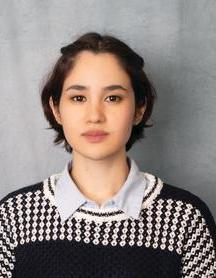
Fatemeh Rezaei
Graduate Assistant, Women's, Gender, and Sexuality Studies
Raised in Iran in an Afghan Hazara family, Fatemeh has lived between Tehran, Dortmund, and now Cincinnati. She completed her BA in Photography at the University of Tehran and later worked as a research fellow with Academy in Exile at TU Dortmund University before relocating to the United States in 2024. She is currently pursuing dual Master’s degrees in Fine Arts (MFA) and Women’s, Gender, and Sexuality Studies at the University of Cincinnati, where her research-based practice focuses on archives, displacement, and the lives of Hazara and Afghan women across Afghanistan, Iran, and the wider diaspora.
More about her work can be found on her website.
More about her work can be found on her website.

Aratrika Sengupta
Graduate Assistant, Women's, Gender, and Sexuality Studies
Ara (he/they) is a multidisciplinary scholar working at the intersections of gender, disability and histories of capitalism. They research the manner in which consumer capitalism culturally produces governable personhood.
He is interested in postructuralist, marxist and new materialisms traditions of thought to theorize the nation state as an oppressive structure. Continuing his thought of everything is connected, he also researches on mapping as a critical archiving impulse, premodern walking histories, histories of gender in colonial contexts and politics of archivization of cultural objects.
He is interested in postructuralist, marxist and new materialisms traditions of thought to theorize the nation state as an oppressive structure. Continuing his thought of everything is connected, he also researches on mapping as a critical archiving impulse, premodern walking histories, histories of gender in colonial contexts and politics of archivization of cultural objects.

Brittany S Theodore
Graduate Assistant, Women's, Gender, and Sexuality Studies
Brittany earned a BA in Sociology with a minor in Women’s, Gender, and Sexuality Studies (WGSS) from the University of Cincinnati. Now a first-year student in the dual PhD/MA program, they are pursuing a PhD in Sociology and an MA in WGSS. Their research, rooted in feminist and Marxist frameworks, engages questions of power and authority, examining how these forces are produced, maintained, resisted, and reimagined. They are particularly interested in the body, including necropolitics, gender, sex and sexuality, and reproductive justice, and seek to investigate how social institutions govern bodies, life, and mortality. Brittany also explores the cultural and political functions of art, imagery, and social movements, exploring how they operate as both tools for social change and social control.