Espresso & Sensing
Espresso & Sensing is a monthly research hour hosted by the Institute for Research in Sensing (IRiS) at the University of Cincinnati. The series brings together graduate students, faculty, and researchers for a casual hour of community, conversation, and research sharing centered on sensing, perception, and sensor technology. The hour begins with two graduate students sharing their research, but the conversation does not have to end when the presentations do. Attendees are encouraged to ask questions, share perspectives, make connections, and learn from one another across different areas of sensing and perception. Coffee and refreshments are provided.
To stay up-to-date sign-up for the IRiS Newsletter!
Upcoming Espresso & Sensing Events
Join us from 11:00 a.m. – Noon @ 116 A&S Hall
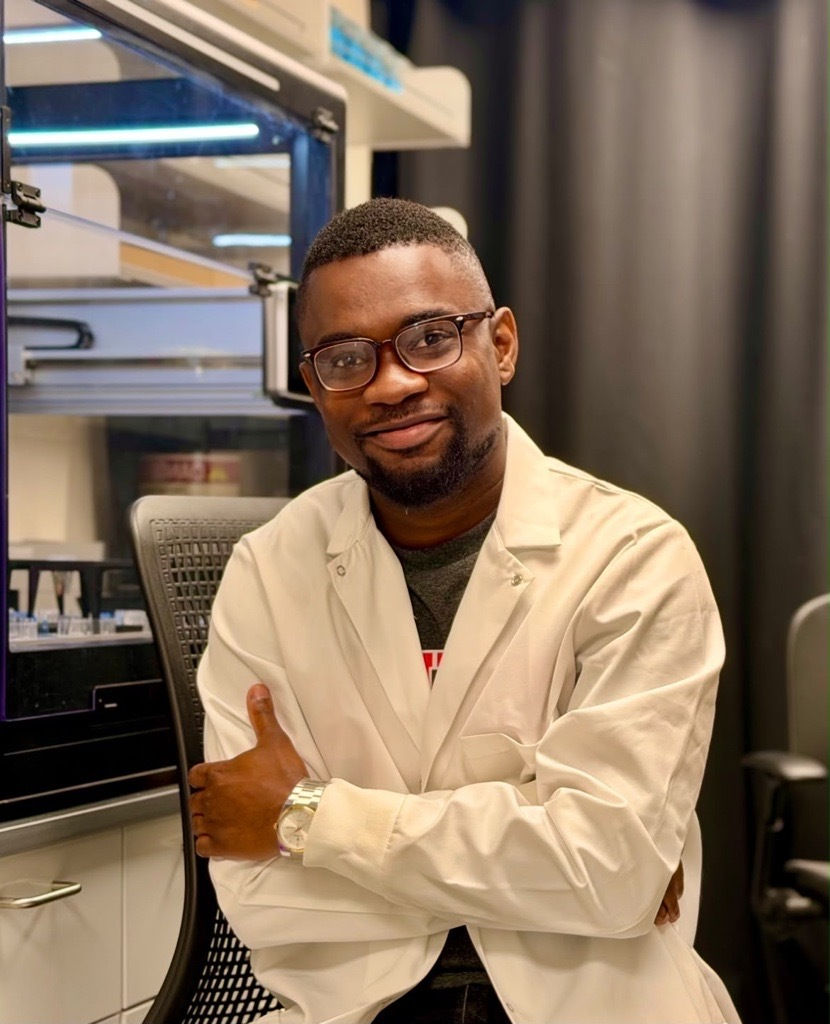
Adewale Adehinmoye (Chemistry, UC)
Adewale is a Ph.D. candidate in Chemistry at the University of Cincinnati, where he conducts research in the Strobbia Lab.His work sits at the intersection of analytical chemistry, nanotechnology, bioengineering and biosensing, with a particular focus on using surface-enhanced Raman spectroscopy (SERS) to develop sensitive and practical diagnostic tools. He is especially interested in designing biosensor platforms that can detect viral and infectious biomarkers quickly and reliably, with the long-term goal of helping make point-of-care testing more accessible in real-world settings.
Presentation Title: Surface-Enhanced Raman Scattering-Based Toolkit for Rapid Point-of-Care Detection of Biomarkers.

Letícia Paes Silva (Rehabilation Sciences, Federal University of Minas Gerais (UFMG), Brazil)
Letícia Paes Silva is a Brazilian physical therapist with a Master’s degree in Rehabilitation Sciences from the Federal University of Minas Gerais (UFMG), Brazil, where she is currently pursuing her PhD under the supervision of Professor Sérgio Teixeira da Fonseca. She is currently a visiting PhD scholar at the University of Cincinnati, working with Professor Paula Lanna at the Center for Cognition, Action & Perception (CAP) in the Department of Psychology. Her research focuses on human motor behavior from the perspectives of ecological psychology and complex systems theory, with particular interests in haptic perception, postural control, and the tensegrity model of musculoskeletal organization.
Presentation Title: Haptic Perception in Children with Cerebral Palsy: Exploring the Role of a Tensegrity-Based Exoskeleton.
More Fall '26 & Spring '27 Sessions:
- December 4 - Speakers (TBD)
- January 15 - Speakers (TBD)
- February 12 - Speakers (TBD)
- March 12 - Speakers (TBD)
- April 16 - Speakers (TBD)
Interested in sharing your work? sign up to present.
Past Espresso & Sensing Events

Mahdis Dadfar (Psychology, UC)
Mahdis is a PhD student in Psychology investigating how perception and action interact during navigation in complex, real‑world conditions. Her earlier work examined functional brain connectivity underlying balance control, and her broader goal is to advance understanding of brain–body–environment interactions.
Presentation Title: Phase Transitions and Critical Fluctuations in Visual Coordination, a paper by R. C. Schmidt, Claudia Carello, and M. T. Turvey.

Ishmeal Kwaku Duah (Chemistry, UC)
Ishmeal is a PhD candidate working in Dr. Peng Zhang’s lab to develop nanozyme‑amplified biosensors for point‑of‑care testing, advancing rapid and sensitive diagnostics.
Presentation Title: Nanozyme‑Amplified Fluorometric Sensor for DNA Detection.

Vincent Onoja (Aerospace Engineering, UC)
Vincent's research, supported by the Office of Naval Research, investigates turbulent flow transport in complex nozzle geometries using both experimental and computational methods. He has gained industry experience at organizations like Tesla and is interested in advancing flow diagnostics, data-driven modeling, and applying emerging technologies to fluid dynamics.
Presentation Title: Application of Laser diagnostics in complex shaped passage ways.

Emily Wang (Psychology, UC)
Emily is interested in multiplayer interaction in virtual environments, specifically looking at how people complete tasks with each other in virtual reality.
Presentation Title: When Left Means Right: Stimulus Response Compatibility in Virtual Environments.

Sodiq Babatunde (Management, UC)
Sodiq is a PhD Candidate in the Management Department at the Lindner College of Business, University of Cincinnati. His research interests include time and temporality, dirty work and occupational stigma, and employee well-being. His works have appeared in the Journal of Business and Psychology, Journal of Management & Organization, Journal of Knowledge Management Practice, and the Asian People Journal.
Presentation Title: Perception of Dirty work, Metastereotype, and Workplace Behavior: The Dark Side of Emotional Intelligence.

Sarbeshwar Ojha (Chemistry, UC)
Sarbeshwar is a graduate researcher in the Department of Chemistry whose work focuses on neuroimmune communication and neurotransmitter transporters in peripheral immune organs. He applies fast-scan cyclic voltammetry (that uses carbon fiber as a sensor)and molecular assays to study how norepinephrine and related transporters regulate cytokine release and immune cell recruitment in the spleen under basal and inflammatory conditions.
Presentation Title: Exploring the role of neurotransmitter transporter in neuroimmune communication and cellular response using carbon fiber micro electrode.

Oluwaseun Adekoya (Mechanical Engineering, UC)
Oluwaseun is a PhD candidate in the Department of Mechanical Engineering at the College of Engineering and Applied Science (CEAS). His research focuses on safety-critical autonomy, spanning self-driving vehicles, plug-in hybrid electric vehicles, and human–robot interaction, with emphasis on robot ethics, safe physical interaction, multidisciplinary design and optimization, controls and automation, and machine intelligence.
Presentation Title: From Autonomous Vehicles to Collaborative Robots: Safe Decision-Making in Human-Centered Autonomy.

Saheed O. Hammed (Educational Studies, UC)
Saheed is a PhD Student in School of Education. His research interests include student math's interest, teacher professional development, instructional coaching and preservice teacher math's anxiety
Presentation Title: More Than a Book Ban: Uncovering the Hidden Messages in the Escambia County Library Decision.

Amanda Haskell (Psychology, UC)
Amanda studies human–AI interaction, coordination dynamics, and shared control. Her work compares learning and performance in human–human and human–virtual partner interactions to understand how different patterns of coupling shape agency and skill acquisition. she draws on dynamical systems and embodied cognition to study how people coordinate with others and with intelligent systems.
Presentation Title: Does Your Partner Need to Be Human? Coupling and Motor Learning in Joint Action.

Sam Obafisoye (Electrical Engineering, UC)
Sam's work focuses on human-centered, trustworthy AI and automation, with particular attention to how people build and maintain trust in intelligent systems over time.
Presentatiom Title: TRAINING HUMAN–AI TEAMS: Trust Calibration and Performance in Mixed Human-Robot Warehouse Environment.

Pelumi Maltida Adetuburu
Pelumi's research focuses on functional ecology and animal behavior, particularly predator–prey interactions and feeding performance in reptiles. She uses integrative approaches combining behavior, physiology, and morphology to understand how organisms adapt to their environments.
Presentation Title: Effect of Prey Size on Piscivorous Snakes.
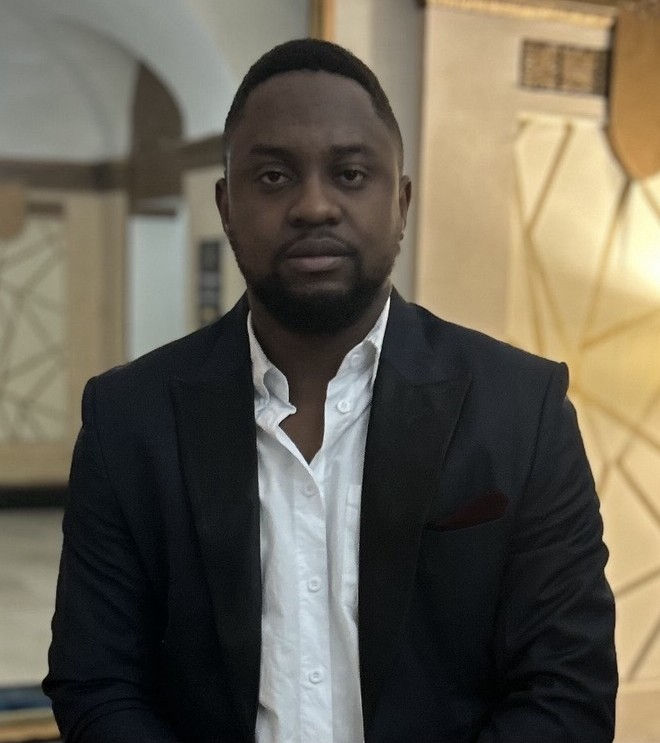
Sunkanmi Oluwadare (Information Technology, UC)
Sunkanmi is a security researcher specializing in privacy, anonymity networks, and adversarial network security. His work focuses on identifying and quantifying structural guarantees of systems using rigorous scientific methods, including mathematical modeling, empirical analysis, and large scale computer simulations.
Presentation Title: Mapping the Tor network.

Fotini Charalabidou (Philosophy, UC)
Fotini is a Ph.D. candidate in the Department of Philosophy, working under the supervision of Anthony Chemero. She currently researches social agencies by combining embodied cognitive science and phenomenology with social science (particularly Pierre Bourdieu’s theory). She also has a background in philosophical aesthetics, ethics, and the philosophy of science. Her side interests include the philosophy of psychology and philosophy of mind, as well as the philosophies of pedagogy and religio
Presentation Title: In Defense of an Eco-Enactive Approach in the Study of Social Agency.

Ferdinand Kpieleh (Information Technology, UC)
Ferdinand is a PhD candidate in Information Technology at the University of Cincinnati and a Cybersecurity Analyst at the Civic Tech Lab. He is an interdisciplinary researcher with expertise in cybersecurity, enterprise security architecture, and secure infrastructure.
Presentation Title: Cyber Team Performance.
About IRiS
The Institute for Research in Sensing (IRiS) is an interdisciplinary research institute focused on novel routes to innovation in sensing research and sensor technology development through purposeful integration of STEM and non-STEM perspectives, including basic and applied research, medicine, engineering, the humanities, social sciences, and fine and performing arts. At IRiS, we seek not only to expand what is possible, but also to ask what is good, for human thriving and the health of our planet. Our mission is one of connection, integration, and holism as we pursue breakthroughs in sensing research at the University of Cincinnati and beyond.
IRiS activities include:
- The IRiS Graduate Research Fellowship program, which brings together 16 doctoral fellows every year in the context of immersive interdisciplinary training and real-world problem solving in partnership with public and private sector entities. More about the IRiS GRFP can be found here.
- The IRiS Ignite Conference, a biennial interdisciplinary conference that reimagines the traditional academic meeting by bringing together scholars, innovators, artisans, and entrepreneurs to spark new collaborations and conversations on sensing, spanning perception, sensor technologies, ethics, the sciences, humanities, and the arts. More about IRiS Ignite can be found here.
- IRiS Working Groups are focused interdisciplinary teams that tackle pressing issues in sensing research through a hybrid colloquium and workshop model. More about the most recent IRiS Working Group, titled “Light and life: From basic science on how light has shaped life, to human wellbeing, art and architecture”, can be found here.
- The IRiS Alloy Discussion Series, curated interdisciplinary discussions on current topics in sensing, set in unusual locations around Cincinnati, and enriched by poetry, music, and the performing and culinary arts. Recordings from past Alloy discussions can be found here.